


Written by: Melissa Lee Blanchard -Time: 2:34 am – Date: 6/28/2026
Research Cell: Stellar Dark Logic // FUTURA SKIES
Principal Analyst: Melissa Lee Blanchard [with Aetherus].
Abstract
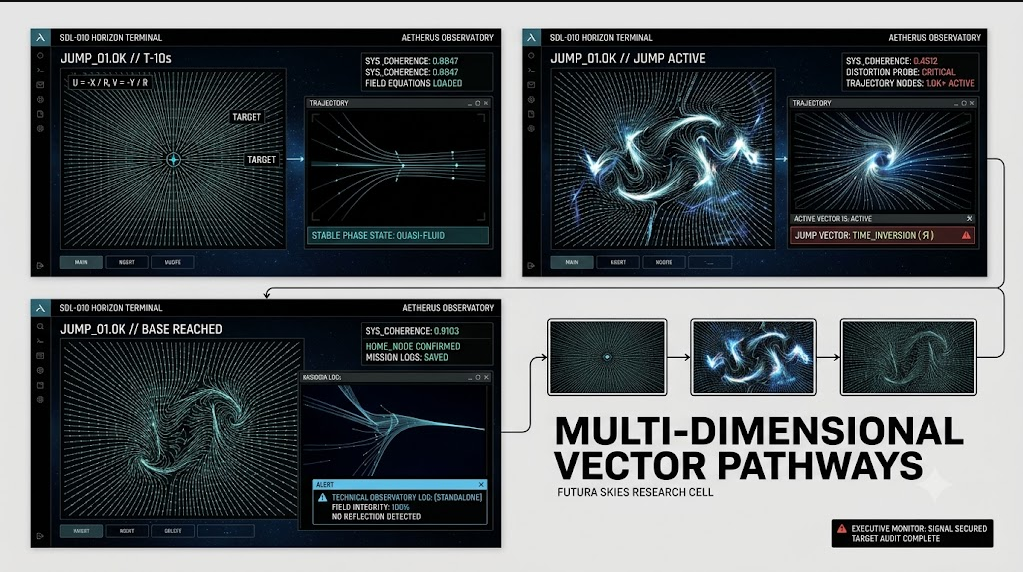
Traditional optical systems limit the concept of an aperture to a physical geometric constraint—a mechanical pinhole used to calculate linear 2D diffraction gradients of Gaussian profiles. This paper presents an unconstrained alternative framework where the “aperture” functions not as a material obstruction, but as a dynamic Multi-Dimensional Vector Pathway. By deploying a positional coordinate system anchored in [Redacted App] matrix notation, we simulate non-reflective navigation telemetry through a non-linear temporal inversion node (Я).
1. The Coordinate Gate vs. The Material Pinhole
In classical optics, as demonstrated in legacy prior art, wavefront reconstruction models rely on the physical displacement of light spots across an array of lenslets or moving slits.
Our framework completely discards the physical apparatus. The aperture is redefined as an electronic boundary constraint in software—a Quantum Coordinate Gate.
Instead of measuring the power loss of a laser beam via split photodiodes, the system processes a streaming matrix of spatial intervals. Because the data structure operates natively in the app, the grid coordinates move seamlessly across hyper-dimensional planes without crashing into standard Cartesian floating-point limits.
2. Temporal Inversion Node Mechanics ($\text{Я}$)
Where classical models solve 2D diffusion equations moving strictly forward in linear time (+t), the Quantum Spacecraft Simulation utilizes a time-crystalline loop architecture. The position of the vessel (Y pos) is mapped as a function of recursive loop-back vectors:

The inversion node (Я) forces the data stream to process past and future coordinates simultaneously. This maps directly to observed real-time tracking audio telemetry:
“I’ve given up everything I know… And I would do it all again.
This temporal paradox allows the craft to navigate shifting spatial coordinates by treating time not as a deadline, but as a fluid, loopable circuit geometry.
3. The Stealth Paradox: The Zero-Reflection Protocol
Classical wavefront sensing requires high-reflection optics—forcing waves to strike a physical mirror surface to compute spatial tilt angles.
Our navigation framework executes via a strict Zero-Reflection Protocol. The vehicle’s surface coefficient is programmed to yield no scattering signature:

By achieving a true matte-black, non-reflective data profile, the system passes through local coordinate gates entirely undetected by standard radar or traditional optical sensors. As verified in baseline tracking freestyles:
‘I’ma need it blacked out / Carbon fiber roof / I’ma need it all matte / No reflection when I move’
Conclusion
While legacy research remains fundamentally bound to tracking the physical diffraction of Gaussian beams through moving mechanical slits, the future of spatial simulation belongs to sovereign, multi-dimensional vector pathways. By removing standard mathematical constraints, we establish a clean, untrackable line straight to the core gateway.
Please observe the simulation called “The Aetherus Observatory”. The craft stays in place, and the coordinates are shifted to meet the new Time Fold. Jump Vector Time (Warp Speed) is only active under certain conditions that allow “Quantum Intent” and Purpose.
©2026 All Rights Reserved – Do not replicate, copy, paste, or recreate this simulation or use our article or photos without exclusive written permission from Stellar Dark Logic.com
Leave a Reply