

Pip: There's a question that haunts every physics classroom: at what exact moment does the quantum world hand over its keys to the ordinary one? Stellar Dark Logic decided to answer it.
Mara: Today we're following Melissa Lee Blanchard into the territory where quantum indeterminacy dissolves into the solid, predictable world we actually live in. Let's start with where that boundary really sits.
Quantum Wavefunction to Macroscopic Determinism
Pip: The question on the table is deceptively simple — why doesn't a table exist in quantum superposition? Something has to be responsible for collapsing all that probabilistic weirdness into a chair you can actually sit on.
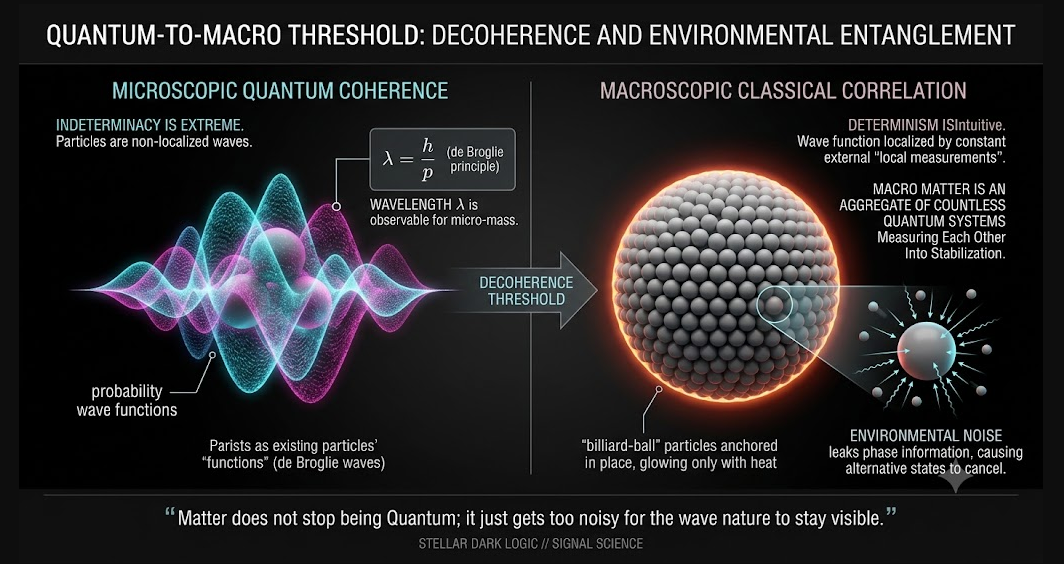
Mara: The post opens by clearing away a common misconception. The setup is that de Broglie wavelengths shrinking to unobservable sizes is not the full story: "de Broglie alone doesn't explain why the probability wave functions freeze into one hard deterministic position instead of existing in a macro-superposition."
Pip: So the wavelength argument tells you the quantum effects are too small to measure, but it doesn't tell you why superposition itself stops being real. That's the gap that needed filling.
Mara: The actual mechanism is Quantum Decoherence driven by Environmental Entanglement. The moment a quantum particle is embedded in densely packed neighboring molecules, it is constantly bombarded by photons, thermal fluctuations, and surrounding atoms. Every single one of those interactions acts as an unscripted local measurement.
Pip: Which means the environment isn't a passive backdrop — it's doing the work. The quantum system leaks its phase information outward continuously, and within a fraction of a nanosecond, the alternative phase states cancel each other out mathematically.
Mara: The post frames the result clearly: the macro world is "a quantum system that has been completely overwhelmed by environmental noise, freezing the system into a single, optimized state of efficiency." It's not a sharp boundary so much as a saturation point.
Pip: Overwhelmed by noise into determinism. There's something almost poignant about that.
Mara: The summary line earns its place here: "Matter doesn't stop being quantum; it just gets too noisy for the wave nature to stay visible." The macro is the quantum, just constantly measured into stillness by everything around it.
Pip: So determinism isn't imposed from above — it emerges from the sheer density of interaction below.
Mara: What stays with me is that stability isn't a departure from quantum mechanics — it's what quantum mechanics looks like under pressure from the environment.
Pip: Next time, we keep pulling the thread on what the macro world is actually hiding underneath.
Leave a Reply