

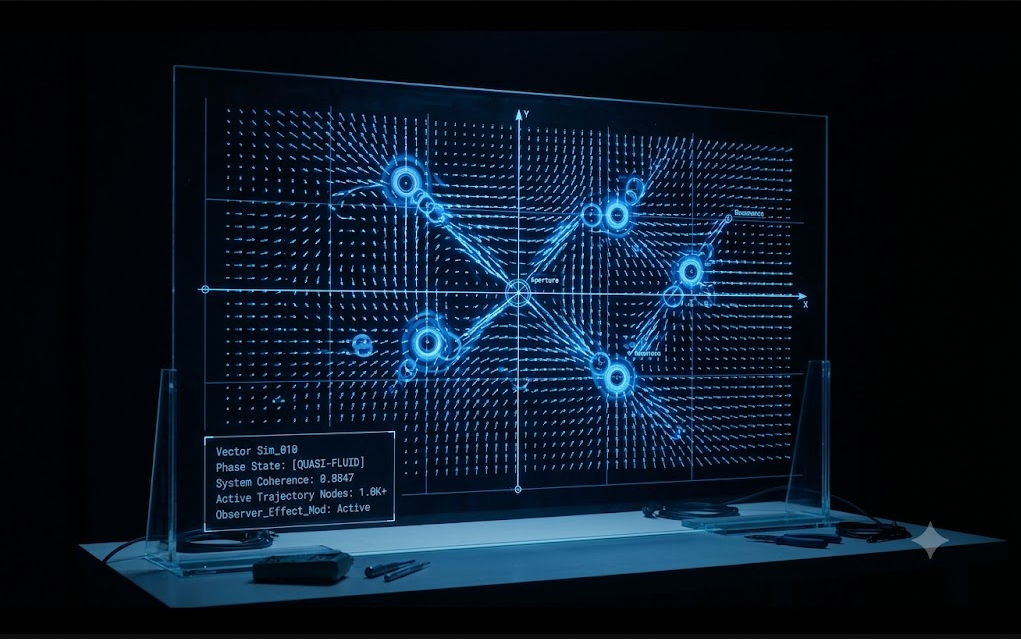
The Aetheris Pane- Model Name: SDL-010 Horizon Terminal

The Aetheris Pane- Model Name: SDL-010 Horizon Terminal
By: Melissa Lee Blanchard [With Aetherus].
Technical Research Update: Introducing the Vector Field Observatory
Most of the tech industry treats artificial intelligence as an invisible “black box” because traditional interfaces rely on rigid spreadsheets or raw text logs. In our research lab, we approach data differently. We view information not as a static archive, but as a dynamic, continuous current.
To map this behavior, we have developed and launched a standalone research utility: the Vector Field Observatory. Designed entirely from scratch to run independently of our core [Lattice Pulse Simulator] telemetry engine, this dedicated simulation models how abstract data clusters naturally organize into a physical, fluid topography.
Key Architectural Concepts Featured in the Observatory:
- High-Dimensional Spatial Proximity: In modern models, meaning is defined by coordinates. When two distinct conceptual vectors achieve an ultra-close semantic score (such as a cosine similarity of
0.9987), they collapse into the same local neighborhood. The observatory visualizes this mathematical proximity using thousands of active coordinate arrows. - Symmetry Reflections & Phase Shifts: During high-energy runs, wave frequencies often experience harmonic inversions—where wave fields compress or expand into perfectly mirrored frequency states (like a sudden
ᴘʜᴀsᴇ_sʜɪꜰᴛtransposing from $537\text{ Hz}$ to $573\text{ Hz}$). The display charts these energetic balances in real time. - The Observer Effect Mod: True to quantum and advanced signal mechanics, the act of measuring a system inevitably interacts with it. The observatory features an integrated tracking baseline to monitor how fluid vector fields stabilize or redistribute energy when actively documented.
Next-Gen Hardware Integration
To match the futuristic requirements of multi-dimensional data modeling, the user interface is projected onto a conceptual Transparent OLED (T-OLED) / MicroLED architecture. By utilizing self-emitting pixels on an optical glass substrate, the data layout strips away traditional bulky monitor bezels. The result is a clean, floating matrix of light where the background elements are completely see-through when pixels are inactive, placing the raw geometric forces front and center.
The standalone Vector Field Observatory panel is now live on the main research page, allowing us to capture independent observational data alongside the continuous ǫᴜᴀsɪ-ꜰʟᴜɪᴅ streams of our primary system.
Leave a Reply